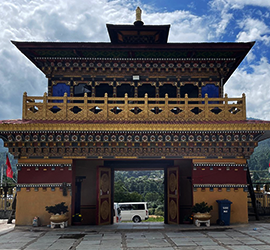
A towering and recently constructed building, adorned with vibrant hues, Könchogsum Lhakhangencases the meticulously restored remnants of the original temple. Dating predominantly from the 15th century, the smaller temple, revitalized by Pema Lingpa, faced near-destruction in 2010 due to a butter-lamp fire. It is believed that elements of the original structure trace back to a Tibetan design from the 6th or 7th century. The present architectural synthesis encapsulates both the historical roots and a contemporary resurgence, creating a harmonious tapestry at this revered site.
The ancient lhakhang preserves its central statue of Nampal Namse (Vairocana), a Dhyani Buddha, flanked on the right by Chenresig and Longchem Rabjampa, the visionary behind Tharpaling Goemba. Positioned on Vairocana's left are statues of Guru Rinpoche and Pema Lingpa, the latter believed to be a reincarnation of Longchem Rabjampa. The courtyard hosts a once-external pedestal, now internalized within the towering walls of the new lhakhang, previously cradling a large and ancient bell. Legend has it that the resonant toll of this bell reached Lhasa, Tibet. In a 17th-century attempt to steal the bell, the Tibetan army dropped it, resulting in a crack. The fragmented relic now rests in the new Kudung Chorten Lhakhang on the upper level of the contemporary structure.
The contemporary edifice stands as a marvel of architecture, boasting massive and brightly adorned columns that ascend to a mandala-painted ceiling. Along the perimeter mezzanine, seated statues depict the diverse reincarnations of Pema Lingpa encompassing mind, body, and spirit. Every surface within is adorned with meticulous murals and intricate designs, creating a visually immersive experience. Flanking the lhakhang are monks' quarters, indicative of this locale evolving into a dynamic hub for Buddhist learning, akin to the transformative rise of a phoenix.
YoEnzo Tours and Treks provides unparalled luxury, adventure, and nature tours, designed to create unforgettable memories

© Copyright 2026 YoEnzo Tours and Treks | Design By Indra Gotamey